Imagine a car that combines the efficiency of an electric vehicle with the flexibility of a combustion engine—without the drawbacks of either. A serial hybrid with supercapacitors does just that. A small, efficient generator provides steady power, while supercapacitors handle peak demands like acceleration or hill climbing. The result? A vehicle that’s up to 40% more efficient, works with any fuel, and needs no charging infrastructure. Supercapacitors make it possible: lightweight, fast-charging, and perfect for regenerative braking. For trucks, buses, or regions without charging stations, this could be a game-changer. And the best part? It’s already feasible—cheaper than a Tesla and as compact as a traditional engine. It’s time to reconsider the serial hybrid as the perfect bridge to a sustainable future.
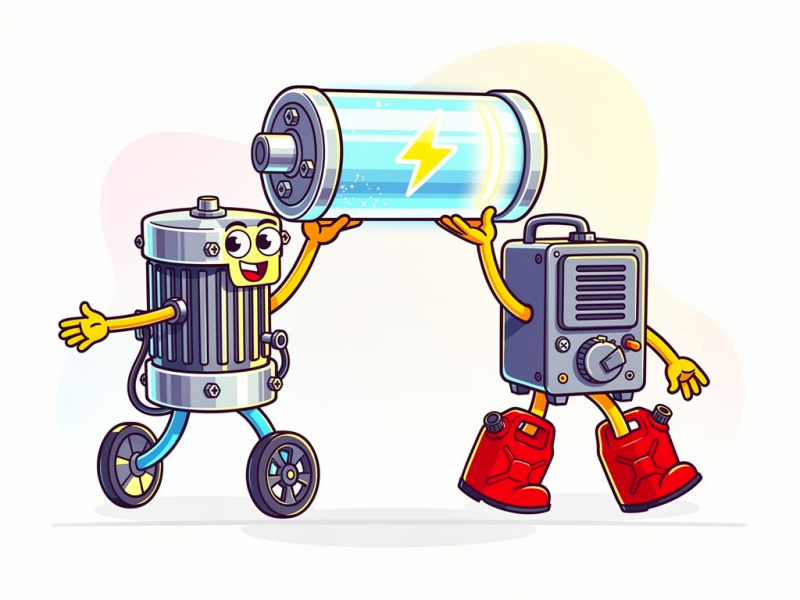
The Revival of Serial Hybrids: How Supercapacitors Could Redefine Automotive Efficiency
Introduction: The Hybrid Landscape and the Overlooked Serial Hybrid
The automotive industry has long been shaped by a few dominant powertrain architectures. Internal combustion engine (ICE) vehicles have been the standard for over a century, while parallel hybrids, such as the Toyota Prius, have gained popularity for their ability to combine the benefits of electric and gasoline power. More recently, battery electric vehicles (BEVs) have emerged as the future of transportation, driven by advancements in battery technology and a global push toward zero emissions. Amidst this evolution, one configuration has remained largely overlooked in the consumer market: the serial hybrid.
In a serial hybrid system, the internal combustion engine—or another type of generator—serves solely as an electricity producer. This electricity powers an electric motor, which in turn drives the wheels. Unlike parallel hybrids, where the engine can directly propel the vehicle, the serial hybrid decouples the engine from the drivetrain entirely. This allows the engine to operate at its most efficient point at all times, minimizing emissions and maximizing fuel economy. Excess energy generated can be stored in a buffer system, traditionally a battery, which then provides additional power during peak demand situations, such as acceleration or climbing hills.
Despite these inherent advantages, serial hybrids have struggled to gain a foothold in the consumer automotive market. Several factors have contributed to this neglect:
- Traditional serial hybrids rely heavily on batteries, which are not only heavy and expensive but also degrade over time. The need for large battery packs to meet peak power demands has made serial hybrids less competitive with parallel hybrids or BEVs in terms of both cost and weight.
- The automotive industry’s focus has shifted toward parallel hybrids and fully electric vehicles, which have benefited from substantial investments in battery technology and charging infrastructure.
- Parallel hybrids, which can directly use the engine’s mechanical power, were long considered more efficient for typical driving cycles. This perception, combined with the commercial success of models like the Toyota Prius, led automakers to prioritize parallel configurations.
However, recent advancements in supercapacitors—devices that can store and release energy much faster than batteries—could change this dynamic.
The Rise of Supercapacitors: A Potential Game-Changer
Supercapacitors, also known as ultracapacitors, are energy storage devices that bridge the gap between traditional capacitors and batteries. Unlike batteries, which store energy through chemical reactions, supercapacitors store energy electrostatically in an electric field. This allows them to charge and discharge almost instantaneously, with efficiencies exceeding 95%.
The key differences between supercapacitors and batteries are summarized in the table below:
| Property | Supercapacitors | Lithium-Ion Batteries |
|---|---|---|
| Energy density | 1–10 Wh/kg | 100–265 Wh/kg |
| Power density | 10–100 kW/kg | 0.1–1 kW/kg |
| Charge/discharge time | Seconds | Hours |
| Cycle life | 1,000,000+ cycles | 500–10,000 cycles |
| Temperature range | -40°C to +85°C | 0°C to +60°C |
| Efficiency | 95–98% | 85–95% |
The limitations of batteries in serial hybrid applications—namely weight, cost, and degradation—are areas where supercapacitors excel. Their ability to deliver rapid bursts of power makes them ideal for handling the peak demands of acceleration or climbing hills, while a generator provides the average power required for cruising. This eliminates the need for a large, heavy battery pack. Additionally, supercapacitors can endure millions of charge-discharge cycles without significant degradation, making them particularly suitable for applications involving frequent power fluctuations, such as stop-and-go city driving.
Another significant advantage is their ability to charge in seconds, which makes them perfect for capturing energy from regenerative braking, a key feature in hybrid systems. Furthermore, supercapacitors can operate effectively across a wide temperature range, typically from -40°C to +85°C, without the thermal management challenges associated with batteries.
Supercapacitors have been commercially available for decades, primarily in industrial and niche applications such as backup power systems, cranes, and public transport. Recent advancements have made them more viable for automotive use. The price of supercapacitors has been decreasing, with current costs ranging from 500 to 1,000 USD per kWh for high-performance models. While this is still higher than lithium-ion batteries, which cost approximately 100 to 150 USD per kWh, the reduced need for large energy storage in a serial hybrid system makes the overall setup cost-competitive.
For a serial hybrid vehicle, a bank of 100 to 150 supercapacitors, each rated at 10,000 Farad and 2.7V, would provide sufficient power buffering for most driving scenarios. This would come at a cost of approximately 3,000 EUR and occupy a volume of around 100 to 140 liters, comparable to the size of a traditional engine.
The Case for Reintroducing the Serial Hybrid
The convergence of several technological and market trends makes the serial hybrid with supercapacitors an attractive proposition today. Modern generators, such as Wankel rotary engines or micro-turbines, can achieve efficiencies of 35 to 45% when running at a constant load, far higher than traditional internal combustion engines in variable driving conditions, which typically operate at 20 to 30% efficiency.
As supercapacitor technology continues to improve, their energy density is increasing, with graphene-based models reaching 30 to 50 Wh/kg, while costs continue to decline. This makes them increasingly viable for automotive applications. Additionally, the flexibility in fuel choice is a major advantage. Serial hybrids can run on any type of fuel, including gasoline, diesel, biofuels, or even hydrogen via a fuel cell. This flexibility is particularly beneficial in regions where electric charging infrastructure is lacking or where synthetic fuels are becoming available.
Another significant benefit is the reduction of range anxiety. Unlike battery electric vehicles, serial hybrids do not rely on charging infrastructure. The generator ensures that the vehicle can continuously recharge its supercapacitors, effectively eliminating range limitations.
While serial hybrids may not replace battery electric vehicles for all use cases, they are particularly well-suited for applications involving frequent stops and starts. The table below highlights some of the most promising applications:
| Application | Advantages | Example Companies |
|---|---|---|
| City buses | Frequent stops and starts allow for maximum energy recovery via regenerative braking. | BYD, Proterra |
| Delivery trucks | Stop-and-go driving in urban areas benefits from supercapacitor buffering. | Wrightspeed |
| Long-haul trucks | Supercapacitors provide power for acceleration and hill climbing. | Nikola |
| Off-road vehicles | No need for charging infrastructure; fuel flexibility is critical. | Military applications |
The primary barriers to serial hybrids in the past—battery weight, cost, and degradation—are mitigated by the use of supercapacitors. With no need for a large battery pack, supercapacitors handle power peaks while the generator provides average power, reducing the size and cost of the energy storage system. Their long cycle life, often exceeding a million cycles, reduces long-term maintenance costs. Additionally, the minimal heat generation of supercapacitors, typically 100 to 250 watts for a 5 kW system, means that passive cooling is sufficient in most cases, eliminating the need for complex and heavy active cooling systems.
Fuel Consumption and Cost Analysis
One of the most compelling arguments for serial hybrids with supercapacitors is their potential for high fuel efficiency. In city driving at an average speed of 30 km/h, a serial hybrid would require approximately 5 kW of average power, with additional peaks for acceleration. Assuming a generator efficiency of 40%, the fuel consumption can be calculated as follows:
Energy required per hour:
E_required = P_generator / η_generator = 5 kW / 0.40 = 12.5 kW
Given the energy content of gasoline (8.9 kWh/liter), the fuel consumption per hour is:
Fuel consumption = 12.5 kW / 8.9 kWh/liter ≈ 1.4 liters/hour
At 30 km/h, this translates to:
Fuel consumption = (1.4 liters/hour / 30 km/hour) * 100 ≈ 4.7 liters/100 km
Thus, the fuel consumption in city driving is approximately 4–5 liters/100 km, which is comparable to diesel hybrids and significantly better than traditional gasoline cars that typically consume 7–9 liters/100 km in city driving.
On the highway at 130 km/h, the power requirements increase to around 20 kW on average, with minimal peaks. With the same generator efficiency, fuel consumption would be approximately 4.5–5.5 liters/100 km, matching or even surpassing the efficiency of many internal combustion engine vehicles on highways.
In hilly terrain at 70 km/h with a 5% grade, the power requirements rise to about 24 kW on average, with additional peaks for climbing. However, regenerative braking can recover around 80% of the energy during descents, significantly reducing net fuel consumption to approximately 4–5 liters/100 km. This is far better than traditional vehicles, which may consume 10–14 liters/100 km in such conditions.
The key insight here is that in hilly terrain, the combination of regenerative braking and constant-load generator efficiency makes serial hybrids with supercapacitors far more efficient than traditional vehicles.
From a cost perspective, a serial hybrid system with supercapacitors can be significantly more economical than a battery electric vehicle. The cost breakdown is provided in the table below:
| Component | Serial Hybrid (Supercapacitors) | BEV (e.g., Tesla Model 3) |
|---|---|---|
| Energy storage | €3,000 (143 × 10,000F supercapacitors) | €8,000–€12,000 (60 kWh battery) |
| Powertrain | €2,000–€4,000 (generator + electric motor) | €1,500–€2,500 (electric motor) |
| Electronics | €2,000–€3,000 (inverters, control systems) | €3,000–€5,000 (battery management, inverters) |
| Total Estimated Cost | €17,500–€26,000 | €30,000–€40,000 |
In terms of volume and weight, the supercapacitor bank would occupy around 100–140 liters, comparable to the size of a traditional engine, and weigh approximately 70–140 kg. The generator, assuming a 20–30 kW unit such as a Wankel or micro-turbine, would weigh around 30–50 kg. This results in a total additional weight of around 100–200 kg, which is significantly lighter than the 300–600 kg of a battery electric vehicle’s battery pack.
Conclusions and Recommendations
The serial hybrid architecture, long overshadowed by parallel hybrids and battery electric vehicles, is poised for a revival thanks to advancements in supercapacitors and generator technology. The ability to allow the generator to operate at its optimal point results in higher fuel efficiency than traditional internal combustion engine vehicles, particularly in stop-and-go traffic or hilly terrain. Additionally, the flexibility to run on any fuel type makes serial hybrids ideal for regions where charging infrastructure is lacking or where synthetic fuels are becoming available.
From a cost perspective, serial hybrids can be cheaper to produce than battery electric vehicles, as they do not require large battery packs. They also offer advantages in terms of weight, as supercapacitor-based systems are lighter than battery-based systems, which is critical for commercial vehicles and performance applications. The longevity of supercapacitors, with their ability to last millions of cycles, further reduces long-term maintenance costs compared to batteries.
However, several challenges remain. Supercapacitors still lag behind batteries in terms of energy density, meaning they cannot store enough energy for long-range driving without a generator. Nevertheless, this is not a limitation for serial hybrids, where the generator provides the average power. Market perception also poses a challenge, as consumers and automakers have largely moved on from hybrids to battery electric vehicles. Education and demonstration of the advantages of serial hybrids will be key to overcoming this.
Regulatory hurdles present another challenge, as many governments are focusing incentives on zero-emission vehicles such as battery electric vehicles and hydrogen fuel cell vehicles. Serial hybrids, which still produce emissions unless using synthetic fuels, may not qualify for the same incentives.
To realize the potential of serial hybrids with supercapacitors, several steps are recommended. First, there should be a focus on developing high-efficiency stop-start generators. Generators optimized for constant-load operation, such as Wankel rotary engines, micro-turbines, or opposed-piston engines, should be prioritized. These generators can achieve efficiencies exceeding 40% at constant load, with minimal weight and volume. The table below summarizes the key candidates for such generators:
| Generator Type | Efficiency | Weight | Volume | Fuel Flexibility | Cost |
|---|---|---|---|---|---|
| Wankel rotary engine | 35–45% | 30–50 kg | Compact | High | Moderate |
| Micro-turbine | 30–40% | 20–40 kg | Compact | Very High | High |
| Opposed-piston engine | 40–45% | 40–60 kg | Moderate | High | Moderate |
| Diesel generator | 35–40% | 50–70 kg | Large | High | Low |
Second, continued improvement in supercapacitor technology is essential. Research into graphene-based supercapacitors to increase energy density to 30–50 Wh/kg, along with efforts to reduce costs to below 200 EUR per kWh, will make serial hybrids even more competitive.
Third, targeting niche markets first can help demonstrate the viability of serial hybrids. Commercial vehicles such as buses, delivery trucks, and long-haul trucks, where the advantages of weight savings and fuel flexibility are most pronounced, should be the initial focus.
Policy support will also be crucial. Governments should consider providing incentives for low-emission hybrids, particularly those that use synthetic fuels or biofuels. Investing in the production and distribution of synthetic fuels can enable carbon-neutral serial hybrids, further enhancing their appeal.
Finally, consumer education is vital. Highlighting the real-world benefits of serial hybrids, such as fuel savings, flexibility, and longevity, can help shift perceptions. Addressing misconceptions and clarifying that serial hybrids are not just a transitional technology but a long-term solution for specific use cases will be important in gaining market acceptance.
In conclusion, while battery electric vehicles will likely continue to dominate the passenger car market, serial hybrids with supercapacitors could revolutionize commercial vehicles, off-road applications, and markets with limited charging infrastructure. The key to success lies in further developing high-efficiency generators, improving supercapacitor technology, and targeting the right niche markets. For automakers willing to innovate, the serial hybrid represents a low-risk, high-reward opportunity to bridge the gap between traditional internal combustion engine vehicles and a fully electric future.
Reactie plaatsen
Reacties